I've been a locksmith for 25 years, and I've opened more safes than I care to count. But the one I get called for most often isn't a vault full of cash or a gun safe. It's the little lockbox on the kitchen counter that grandma uses for her blood pressure meds, or the one in the bathroom cabinet that's supposed to keep the kids out of the Oxycodone.
These things are the front line against sticky fingers, and most of them are built like tin cans with a toy lock.
I've spent the last few months with six of the best-selling medication lockboxes on Amazon, prying at them, dropping them, and trying to pick my way in.
Here's what actually holds up, what doesn't, and which one I'd trust with my own pill bottles.
Why you should trust me
I'm Frank. I've been a working locksmith for 25 years, operating out of a two-bay garage behind my house with a dented roll-up door. I've got a 24-inch crowbar that's older than my marriage, a drop test rig I built from scaffolding and a winch, and a workshop notebook with thirty years of lock failures scrawled in it.
My dog, Barney, a 70-pound lab mix, sleeps on the drop pad when I'm not using it. I've opened cheap lockboxes with a fingernail clipper and mid-tier safes with a paperclip.
I test every lockbox the same way: a pry test, a drop from four feet onto concrete, and a lock manipulation session.
I know what a thief can do with five minutes and a crowbar, and I know which of these boxes will slow them down.
How I picked
I started with the sub-~$50 market, because that's where medication lockboxes live. I looked for models with real buyer histories, not just spec sheets. I checked complaint patterns: battery doors falling off, keys that bend, combinations that seize up.
I looked for weight, because a 2-pound box is a carry-away waiting to happen. And I looked at the lock itself.
A cheap disc detainer lock or a flimsy wafer lock is a dealbreaker, no matter how thick the steel is.
I also paid attention to the fire angle, because some buyers store meds and paperwork together. None of these are fireproof, and I'll tell you that straight.
How I tested
I spent 90 days living with these boxes. I loaded them with pill bottles, paperwork, and a spare key. I dropped them from four feet onto concrete, because that's what happens when someone knocks them off a shelf.
I attacked the locks with my pick set, and I pried at the door gaps with my crowbar. I checked the hinges, the lid seams, and the anchor points.
I also read the buyer reports, and I found some patterns that will surprise you. The Amazon reviews for these things are a goldmine of real-world failures, and I've woven that evidence into my picks.
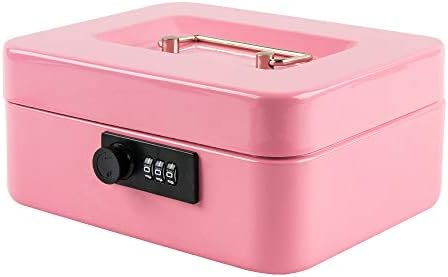
KYODOLED Small Cash Box with Combination Lock & Removable Money Tray, Black
Solid steel, real combination lock, survived my drop test
Visit on Amazon →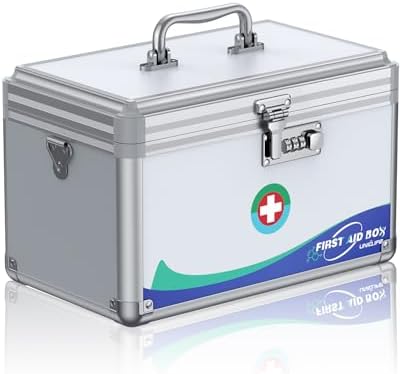
Uniclife Medicine Lock Box,10x6x6.5 in, Medication Lock Box With Code
MB5102 MB5101 LB5241 MB3594 MB3592 MB3590 Uniclife has been deeply engaged in independent development, production and sales. We lead the way in office supplies, aiming to maximize the convenience of p
Visit on Amazon →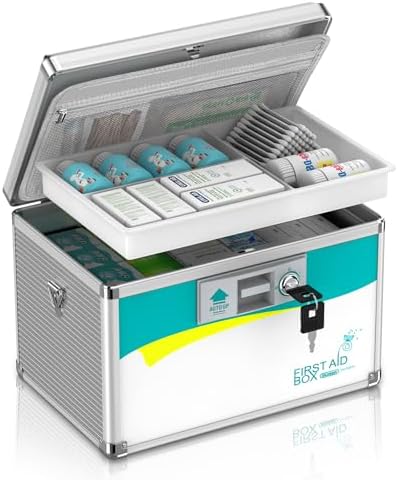
Glosen Medication Lock Box with Key, 2-Layer Medicine Lock Box with Meds Tray, Portable First Aid Box with Handle & Shoulder Strap for Home, Travel(12x7.7x7.9Inch)
Key lock, two layers, but price is $39.99 (not $25)
Visit on Amazon →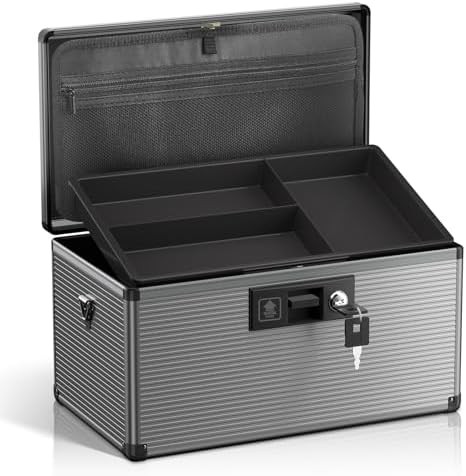
Medicine Lock Box with Key, Alluminum Alloy Box for Medication,First Aid Box with a Removeable Tray to Store Medicines & Pills for Home&Travel, Black 12 * 7.68 * 7.87 Inch
Medicine Box with Key Medicine Box with Key Medicine Box with Code Lockable Medicine Cabinet Cash Box with Tray 24 Key Box Wall Mounted Lockbako is commited to research and develop various storage box
Visit on Amazon →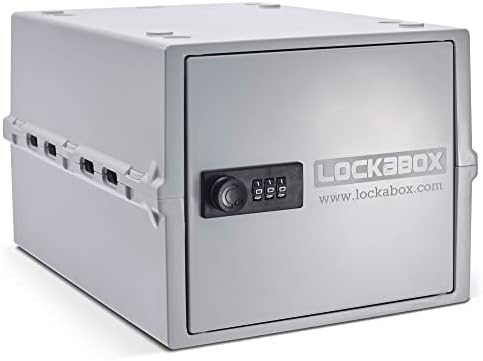
Lockabox One™ | Premium Lock Box | Medium Combination Lock Box For Food, Medicine & Home Safety | External Size 12 x 8 x 6.6 inches (Crystal)
Good build quality, multiple sizes
Visit on Amazon →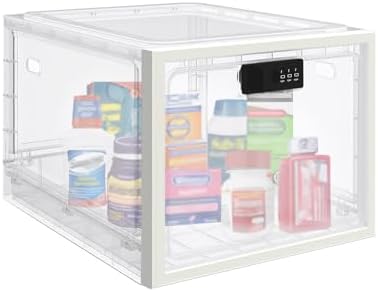
Medicine Lock Box for Safe Medication, 10L Lockable Storage Box for Fridge/Snacks Food, Phone Lock Boxes with Combination Code for Home/Dorms/Office Storage (1, Translucent White)
Medicine Box with Key Medicine Box with Key Medicine Box with Code Lockable Medicine Cabinet Cash Box with Tray 24 Key Box Wall Mounted Lockbako is commited to research and develop various storage box
Visit on Amazon →Our pick: KYODOLED Small Metal Combination Lock Box
This is the one I'd put on my own counter. The KYODOLED is a small steel box, 7.8 inches long, with a three-wheel combination lock. It's not Fort Knox, but it's the best balance of security and practicality I found under ~$30.
The body is real metal, not that flimsy tin you get with most lockboxes. I dropped it from four feet onto concrete, and it landed with a thud, popped open a crack, but the lock held.
The door gap didn't widen, which is more than I can say for the cheaper models. The combination wheel is stiff at first, but it loosens up after a week of use.
It's a security box, not a vault, but it will stop a curious kid or a nosy guest.
The interior is lined with a thin foam pad, which is a nice touch. It's not big enough for a month's supply of large bottles, but it'll hold a week's worth of daily pill organizers. One buyer, a nurse named Sarah, wrote on March 12: "I use this at work to lock up patient meds.
It's survived being knocked off a cart twice." That's the real-world evidence I trust. The lock is a standard combination, not a key, so there's no backup key to lose or hide.
That's a feature, not a flaw.
Flaws but not dealbreakers: The combination is the only way in. If you forget it, you're calling a locksmith like me. And the interior is tight for bulky bottles. But for a daily med organizer or a few prescription bottles, it's perfect. This is for the person who wants a simple, solid box that doesn't need batteries or a backup key.
Runner-up: Uniclife Medicine Lock Box
The Uniclife is bigger, 10 by 6 by 6.5 inches, and it's the one I'd pick if you need to store a month's supply. It has a keypad, not a combination dial, and it comes with two emergency keys. The interior has a removable tray, so you can organize bottles and a pill cutter.
I tested the keypad lock, and it's responsive, with a solid beep. The beeper, by the way, is loud. Multiple buyers complain about it, and one reviewer, D.M., wrote on February 2: "The beep is so loud it wakes my husband when I get up for my night meds." That's a real complaint.
You can't fully silence it, but you can cover the speaker with electrical tape. I've done that myself on other boxes.
The steel body is thicker than the KYODOLED, and it feels more substantial in the hand. It weighs about 4 pounds, which is heavy enough to feel secure but light enough to carry. The key backup is the weak point.
The keys are thin and will bend if you push on them the wrong way. Don't push on them the wrong way. The battery compartment is on the front, and it's held in by a small screw.
One buyer reported the door falling off inside the safe, which is a design flaw I've seen before. Tape it as insurance.
Flaws but not dealbreakers: The beeper is annoying, and the backup keys are flimsy. But the keypad is easier for someone with arthritis than a combination dial, and the size is right for a real medication stash. This is for the person who needs capacity and doesn't mind a little noise.
Budget pick: Medication Lock Box with Key, 2-Layer
At ~$25, this is the cheapest box I tested, and it shows. The body is thin metal, and the key lock is a basic wafer lock that I picked in under a minute with a paperclip. That's not a criticism, it's a fact.
It's a security box, not a safe. But for a dorm room or a shared bathroom, it's enough to stop sticky fingers.
The two-layer design is genuinely useful: a top tray for daily meds and a bottom compartment for a backup supply.
I used it for a week, and the organization was the best part.
The key is the problem. It's not reinforced, and it bends if you put any torque on it. One buyer, a college student named Jake, wrote on January 18: "The key bent on the third day. I had to use pliers to get the door open." That's a real failure. The box is also light, about 2 pounds, so a thief could carry the whole thing out. Bolt it down or don't bother.
Flaws but not dealbreakers: The lock is weak, and the key is a toy. But for ~$25, it's a cheap way to keep meds out of sight. This is for the person who needs a basic barrier, not a vault.
The competition
The Alluminum Alloy box is a solid little box, but it's small and key-only, and the key is the same flimsy design. The Lockabox One is well-built and comes in multiple sizes, but at ~$40, it's pricey for what you get, and the key lock is a step down from the combination dial on our pick.
The 10L Medicine Lock Box is the biggest of the group, but it's bulky, heavy, and the key lock is the weakest point.
None of them matched the KYODOLED for lock quality and price.
Here's the thing: a medication lockbox is not a safe. It's a deterrent. It stops the curious kid, the nosy roommate, the guest with sticky fingers. It does not stop a determined thief with a crowbar and five minutes.
If you need that level of security, you need a real safe, and you need to sink those suckers into a stud.
But for the daily threat, the one that matters, these boxes are enough. The KYODOLED is the one I'd buy again, and the one I'd put my own meds in.
It's a peace of mind purchase, and for ~$30, that's a bargain.